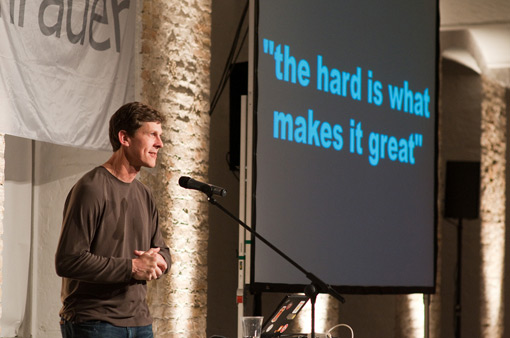
Steve Souders @ JSConf.eu – Image by holgerblank via Flickr
1) The following does not necessarily represent the opinion of Philipp or apdevblog.com. This is the personal opinion of Aron.
2) I love Flash! And I’ll be a Flash developer in the future.
Two weeks ago I spent a very interesting time at JSConf.eu, the small sister of the famous JavaScript conference JSConf. Besides a lot of interesting technical talks, I found it especially interesting, how all this relates to the future of Flash.
Since then, I`ve been spending some time, thinking about the directions that Flash will turn to in the future, especially considering how Adobe still tries to make Flash an industry standard for RIA’s both on classic desktop devices and on non-desktop devices like mobile phones.
Only open (source) technologies rule the web
With the flex framwork Adobe delivered a proper application framework, that enables developers to program applications in a more smart, more maintainable, more efficient way. Now even developers from high level languages (like C or Java) have an eye on Flash (Flex). Flash finally lost the stigmata of annoying banners, stupid intros and useless navigations.
But what does it help when the big industry players do not count on it? The big ones will never put their applications (which is sometimes their business model) in the hands of a plugin, kept, developed and maintained by a relatively small software company, that has not always been listening to the business demands and community requests.
The big players are developing big-time web applications, that will provide their services to millions of users, as we speak. They build it on top of a proven and tested soil of HTML and JavaScript, knowing that – although there are still limitations – lots of open and closed source developers are enhancing that platform.
… which is especially true on non-desktop devices
With the open screen project and the Flash player 10.1 Adobe currently tries to get their feet in the door of non-desktop devices. But they are soooo far behind, I would recommend Adobe to save the money.
The HTML/JavaScript tag-team is already on the spot on every serious non-desktop device out there, like the iPhone and the Wii or white label tv boxes. For Palm Pre JavaScript is even the programming language to develop apps with. Not to forget a complete OS coming based on JavaScript.
Back to the roots guys!
The “oooohhh” and “aaaahhhh” we earned ten or more years ago made Flash what it is today. The graphic capabilities were always the unique selling point of Flash. So unique that there is a penetration of 99% on desktop devices. Flash has the most creative developers out there. So let’s do it again: Build creative websites for classic browsers. Let’s make the client and agencies happy, let’s win some more FWA’s.
Let’s get the designers back on board (remember: they made flash big!). Let’s figure out a way how they can build astonishing stuff again, without the complexity (and fear) of a big programming language (maybe a first step?).
Bottom line
The point I’m trying to make is: The words “application” and “Flash” in one sentence still does not sound natural to me. Sure, with Flash you can build applications, but applications should not necessarily be built with Flash even if Adobe says so.
In the future there will be tons of applications that happen to take place online. Don’t expect Flash to be the tool to create those applications. Expect Flash as what it always has been: A tool to create emotional, surprising, perfectly designed: fun-applications.
How does this concern you?
Don’t get me wrong, I still think there are lots of use cases for Flex. So if you’re a Flex developer there are busy times ahead of you. But don’t expect to build web apps that will change the way we use the web.
If you call yourself a straight AS3 developer you also have lots of things to do in the future. The brands will shift more and more media money into the online sector. There will be a strong demand of developers who create brands online.
In case you have an idea for an online business, a plan to create the next big thing, or you want to be part of a startup sometimes … don’t count too much on Flash.